How it works
What runs where, and the terms the rest of the docs use: the core, frames, origins, rules and the bridge.
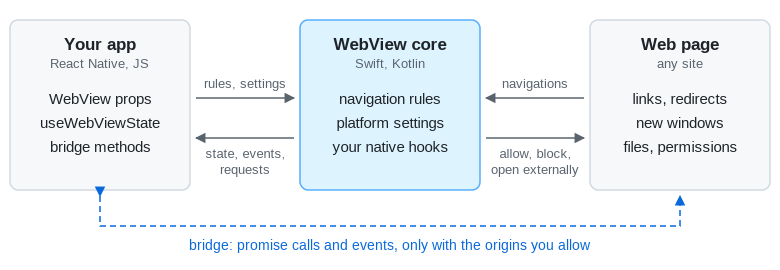
The parts
| Part | What it is | What it does |
|---|---|---|
| The page | Your site, in the platform's WebView: WKWebView on iOS, Android System WebView on Android |
Runs in the WebView's own process, the renderer, apart from the app |
| The core | This package's Swift and Kotlin around that WebView | Decides navigations, keeps the navigation state, answers the page's requests, carries the bridge |
| Your app's JS | The <WebView> props, its ref and your callbacks |
Hands the core its rules and settings, and hears what happened |
| A native hook | Your own Swift or Kotlin, optional | Gets the native WebView itself (native hooks); its JS side goes in the extensions prop, as the extensions package's hooks do |
The core decides natively, from what the props gave it, so a busy JS thread doesn't hold the page up. JS is asked only
where a prop says so: an ask rule (onNavigationRequest), an external navigation when you
pass onOpenExternal, and the page's requests for files and permissions
(page requests).
The bridge carries calls between your app's JS and the page's: the page has window.nativeBridge, and the app has
the object createBridge makes, passed as the bridge prop.
Frames and origins
The main frame is the page's top-level document, the one whose URL the navigation state shows. Every <iframe> in
it is a frame of its own.
An origin is a scheme, host and port, as the page's location.origin writes it: https://example.com. A page from
an html source without baseUrl, a data: URL or a sandboxed iframe has an opaque origin, which only '*' matches.
The core gives the main frame more than it gives iframes, and trusts only the origins you name:
| Feature | Main frame | Iframes |
|---|---|---|
| Navigation state | Its url is this frame's |
Never change its url |
| Navigation rules | Decided | Decided on iOS; on Android only for non-http(s) URLs |
| The bridge | On the bridge's allowedOrigins |
Never |
| Injected scripts | On the script's origins |
Only with allFrames, each frame matched by its own origin |
evaluate |
Runs here | Never |
| Camera and microphone | Asks your onPermissionRequest |
Denied without asking, except on Android one on the main frame's origin |
How a navigation is decided
- These load in place without the rules: the
sourceload,load(url), reloads, back and forward, form POSTs, andabout:,data:andjavascript:URLs unless they open a new window. A redirect of thesourceload or aloadgoes to the rules;navigationRuleslists each case per platform. - Any other navigation goes down
navigationRules, and the first rule that matches decides:allow,block,externalorask. - A navigation no rule matches is blocked.
Without the prop, the rules are defaultNavigationRules. onNavigation
reports every decision with the index of the rule that made it.
Which props recreate the WebView
Only two props recreate the native WebView when they change, which reloads the page: bridge, compared by
identity (keep it stable), and
ios.configuration, compared by value. Everything else, callbacks included, can be written inline.